
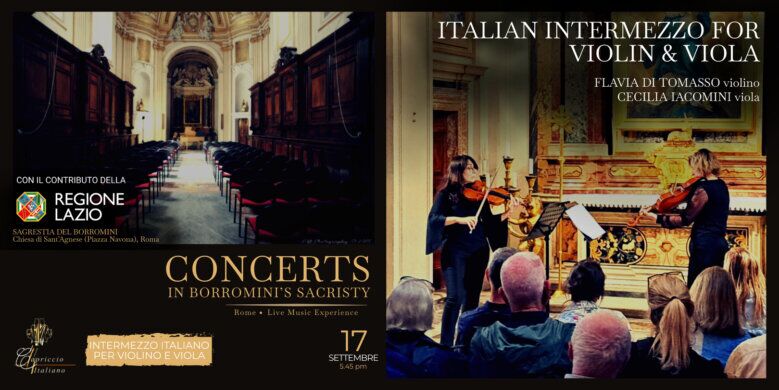
Concerts in Borromini’s Sacristy: 17 settembre
SAGRESTIA DEL BORROMINI, Chiesa di Sant’Agnese (Piazza Navona), Roma
STARTING AT 5.45 PM (the concert lasts one hour)
ITALIAN INTERMEZZO FOR VIOLIN & VIOLA
FLAVIA DI TOMASSO: violino
CECILIA IACOMINI: viola
PROGRAM
di Georg Philipp Telemann (1681/1767)
Canonic Sonata n° 1 in Sol Maggiore
(Vivace, Adagio, Allegro)
di Antonio Vivaldi (1678/1741)
Sonata in Fa Maggiore RV 68
(Adagio, Andante, Allegro moderato)
di Arcangelo Corelli (1653/1713)
"Follia" dalla Sonata op.5 n. 12
di Luigi Boccherini (1743/1805)
Duo in sol maggiore op. 5 n. 3
(Andante, Allegro assai, Minuetto/Cantabile)
di Wolfang Amadeus Mozart (1756/1791)
Duo in Sol maggiore KV 423
(Andante/Rondeau)
Intermezzo Italiano per Violino e Viola attraversa il Settecento seguendo il dialogo tra due strumenti vicini per natura e costruzione, ma profondamente diversi nel colore: luminoso, agile e penetrante il violino; più scura, calda e avvolgente la viola. Il percorso prende avvio da Georg Philipp Telemann e dalla sua straordinaria capacità di riunire le diverse esperienze musicali europee del suo tempo, per entrare poi nel cuore della tradizione strumentale italiana con Antonio Vivaldi e Arcangelo Corelli. Con Luigi Boccherini il linguaggio si sposta verso la sensibilità galante e classica, mentre Mozart conduce il dialogo tra violino e viola a un equilibrio nel quale i due strumenti diventano interlocutori pienamente paritari. Il carattere “italiano” del programma non risiede dunque soltanto nella provenienza dei compositori. Nel Settecento la musica strumentale italiana — e in particolare la scuola violinistica — esercitò un’influenza decisiva in tutta Europa. Telemann ne assorbì energia, chiarezza e cantabilità; Mozart ne ereditò e trasformò molti principi di trasparenza ed eloquenza melodica. Ascoltate in successione, queste pagine raccontano anche l’evoluzione di un modo di fare musica insieme. Dal rigore del canone e dall’intreccio contrappuntistico si passa alla variazione, al canto, alla brillantezza virtuosistica e infine a una vera conversazione tra due voci indipendenti. È proprio nell’alternarsi di affinità e contrasto che violino e viola rivelano tutta la ricchezza della loro relazione sonora.
Italian Intermezzo for Violin & Viola journeys through the eighteenth century by following the dialogue between two instruments that are closely related in construction yet profoundly different in colour: the violin bright, agile and penetrating; the viola darker, warmer and more enveloping. The programme opens with Georg Philipp Telemann and his remarkable ability to bring together the different musical traditions of eighteenth-century Europe, before moving into the heart of the Italian instrumental tradition with Antonio Vivaldi and Arcangelo Corelli. With Luigi Boccherini, the language moves towards the galant and Classical style, while Mozart brings the relationship between violin and viola to a remarkable balance in which the two instruments become fully equal partners. The “Italian” character of the programme therefore lies not only in the nationality of its composers. During the eighteenth century, Italian instrumental music — and violin playing in particular — exerted a profound influence throughout Europe. Telemann absorbed its energy, clarity and lyricism; Mozart inherited and transformed many of its ideals of transparency and melodic eloquence. Heard in sequence, these works also trace the changing nature of making music together. From the discipline of canon and contrapuntal interplay, the programme moves towards variation, lyricism and instrumental brilliance, finally arriving at a genuine conversation between two independent voices. Through this interplay of affinity and contrast, violin and viola reveal the full richness of their musical relationship.
NOTE AI SINGOLI BRANI / NOTES ON THE WORKS
GEORG PHILIPP TELEMANN (1681–1767)
Canonic Sonata n. 1 in Sol maggiore
Vivace – Adagio – Allegro
Il concerto si apre con una pagina che pone immediatamente al centro il principio del dialogo. La prima delle Canonic Sonatas di Georg Philipp Telemann è costruita secondo la tecnica del canone: una voce presenta il materiale musicale e l’altra lo riprende seguendone il percorso, dando origine a un intreccio nel quale imitazione e indipendenza convivono continuamente. Ciò che potrebbe apparire come un rigoroso esercizio contrappuntistico diventa, nelle mani di Telemann, una musica naturale, brillante e comunicativa. Il compositore possedeva una straordinaria capacità di assimilare linguaggi diversi e il suo stile riunisce elementi della tradizione tedesca, francese e italiana. Proprio l’influenza italiana emerge nella chiarezza delle frasi, nell’impulso ritmico e nella facilità con cui la linea melodica sembra trasformarsi in gesto.
Nella versione per violino e viola il principio del canone acquista una particolare evidenza. Le due voci possono seguire lo stesso disegno, ma non possiedono lo stesso colore: quando una frase passa dal violino alla viola, ciò che viene ripetuto non è mai percepito come una semplice copia. Il registro e il timbro trasformano la risposta, permettendo all’ascoltatore di seguire con particolare chiarezza il movimento della musica da uno strumento all’altro. Il Vivace iniziale presenta subito questo gioco con energia e leggerezza. Le linee sembrano rincorrersi, ciascuna conservando una propria identità pur essendo strettamente legata all’altra. Nell’Adagio il meccanismo imitativo assume invece un carattere più meditativo: le distanze tra le frasi diventano spazio espressivo e il contrasto timbrico tra violino e viola acquista maggiore profondità. L’Allegro conclusivo restituisce slancio al discorso e mostra il lato più luminoso e giocoso della scrittura di Telemann. Posta all’inizio del programma, questa Sonata introduce dunque una delle idee fondamentali dell’intero concerto: due voci possono essere strettamente unite senza perdere la propria individualità.
The concert opens with a work that immediately places the idea of dialogue at its centre. Georg Philipp Telemann’s first Canonic Sonata is constructed according to the principle of canon: one voice introduces the musical material and the other follows its path, creating a texture in which imitation and independence constantly coexist.
What could have become a strict contrapuntal exercise is transformed by Telemann into music of remarkable naturalness, brilliance and communicative energy. He had an exceptional ability to absorb different musical languages, and his style brings together elements of the German, French and Italian traditions. The Italian influence can be heard especially in the clarity of the phrases, the rhythmic impulse and the ease with which melody becomes musical gesture. In a version for violin and viola, the canonic principle becomes particularly vivid. The instruments may follow the same musical design, but they do not possess the same colour: when an idea passes from violin to viola, its repetition is never perceived as a mere copy. Register and timbre transform the response, allowing the listener to follow the movement of the music from one instrument to the other with unusual clarity. The opening Vivace introduces this interplay with energy and lightness. The lines seem to pursue one another, each maintaining its own identity while remaining inseparably linked to the other. In the Adagio, the imitative process takes on a more reflective quality: the distance between phrases becomes an expressive space, while the contrast between violin and viola gains greater depth. The concluding Allegro restores momentum and reveals the brighter and more playful side of Telemann’s writing. Placed at the beginning of the programme, the Sonata therefore introduces one of the central ideas of the entire concert: two voices can remain closely connected without sacrificing their individuality.
ANTONIO VIVALDI (1678–1741)
Sonata in Fa maggiore RV 68
Adagio – Andante – Allegro moderato
Con Antonio Vivaldi il programma entra direttamente nel cuore della tradizione strumentale italiana. La Sonata RV 68 appartiene alla produzione cameristica del compositore veneziano ed è originariamente destinata a due violini con basso continuo: una formazione nella quale le due voci superiori possono intrecciarsi, imitarsi e scambiarsi continuamente il materiale musicale. Nella trasposizione per violino e viola, la vicinanza delle due linee originarie si trasforma in un incontro fra registri differenti. Il violino porta naturalmente con sé una maggiore luminosità, mentre la viola conferisce alla seconda voce una profondità e una densità nuove. Il risultato mette in risalto non soltanto la costruzione contrappuntistica, ma anche il colore del dialogo. Uno degli aspetti più affascinanti della musica strumentale di Vivaldi è la capacità di ottenere una straordinaria varietà a partire da elementi molto chiari. Piccoli motivi ritmici, frammenti melodici e figure riconoscibili vengono scambiati, ripetuti e trasformati. La musica conserva così una sensazione di immediatezza, ma sotto questa apparente semplicità si trova un preciso equilibrio tra le parti.
Nell’Adagio iniziale prevale una dimensione raccolta, nella quale il rapporto fra le due voci può essere ascoltato quasi come uno scambio di frasi vocali. L’Andante mantiene la chiarezza del discorso ma gli conferisce un movimento più continuo, mentre l’Allegro moderato conclusivo porta in primo piano l’energia ritmica e la brillantezza tipiche della scrittura vivaldiana. Il passaggio da Telemann a Vivaldi permette anche di ascoltare due modi diversi di intendere l’imitazione: nel primo il canone costituisce il principio stesso della composizione; nel secondo il dialogo è più libero e il materiale musicale circola tra le parti con maggiore mobilità.
With Antonio Vivaldi, the programme enters directly into the heart of the Italian instrumental tradition. Sonata RV 68 belongs to the Venetian composer’s chamber output and was originally scored for two violins and basso continuo, a setting in which the two upper voices can intertwine, imitate one another and continually exchange musical material. In a version for violin and viola, the closeness of the two original lines becomes an encounter between different registers. The violin naturally brings greater brightness, while the viola lends the second voice a new depth and density. The result highlights not only the contrapuntal design but also the changing colour of the dialogue. One of the most fascinating features of Vivaldi’s instrumental music is his ability to create extraordinary variety from very clear materials. Short rhythmic ideas, melodic fragments and immediately recognisable figures are exchanged, repeated and transformed. The music therefore retains a sense of spontaneity, while beneath its apparent simplicity lies a carefully balanced relationship between the parts. The opening Adagio creates a more intimate atmosphere, in which the relationship between the two voices can almost be heard as an exchange of vocal phrases. The Andante preserves the clarity of the discourse while introducing a more continuous motion, and the final Allegro moderato brings rhythmic energy and the characteristic brilliance of Vivaldi’s instrumental writing to the foreground.
The transition from Telemann to Vivaldi also allows us to hear two different approaches to imitation: in Telemann, canon forms the very basis of the composition; in Vivaldi, the dialogue is freer, with musical material moving more flexibly between the parts.
ARCANGELO CORELLI (1653–1713)
“Follia” dalla Sonata op. 5 n. 12
Con La Follia il concerto incontra uno dei grandi archetipi della musica europea. Pubblicata a Roma nel 1700 come dodicesima e ultima Sonata dell’op. 5 di Arcangelo Corelli, la composizione utilizza l’antico schema della Follia, una successione armonica già diffusa da lungo tempo in Europa e utilizzata da numerosi compositori come base per variazioni. Corelli ne ricava una sequenza di ventitré variazioni per violino e continuo. La forza della pagina nasce dal contrasto tra una struttura che rimane riconoscibile e una superficie musicale che cambia continuamente. Il tema iniziale è volutamente semplice e solenne: deve imprimersi nella memoria, perché sarà il punto di riferimento attraverso tutte le trasformazioni successive. Da quella struttura prendono forma variazioni ora liriche, ora ritmicamente incisive, ora apertamente virtuosistiche. Cambiano le figurazioni del violino, la velocità del movimento, l’articolazione e il peso espressivo; ciò che rimane è il profilo armonico della Follia, una sorta di architettura invisibile che continua a sostenere la musica mentre tutto ciò che la circonda si trasforma. Nella versione per violino e viola, il rapporto originario tra linea solistica e sostegno armonico viene ripensato attraverso due strumenti ad arco. La viola può dare corpo alla struttura armonica ma, allo stesso tempo, il suo timbro permette di rendere più evidente il carattere dialogico della trascrizione. L’ascolto si sposta così dalla pura esibizione virtuosistica alla relazione tra le due voci. La Follia rappresenta inoltre un momento importante nel percorso del concerto perché introduce il principio della variazione. Dopo l’imitazione canonica di Telemann e l’intreccio più libero di Vivaldi, Corelli mostra come una stessa idea possa attraversare molte identità diverse senza perdere la propria essenza.
With La Follia, the programme encounters one of the great archetypes of European music. Published in Rome in 1700 as the twelfth and final Sonata of Arcangelo Corelli’s Op. 5, the work is based on the ancient Follia pattern, a harmonic progression that had long circulated throughout Europe and was used by many composers as the foundation for variations. Corelli builds from it a sequence of twenty-three variations for violin and continuo. The power of the piece lies in the contrast between a structure that remains recognisable and a musical surface that is constantly changing. The opening theme is deliberately simple and solemn: it must remain in the listener’s memory because it will serve as the point of reference throughout all the transformations that follow. From this foundation emerge variations that are by turns lyrical, rhythmically incisive and openly virtuosic. Violin figurations, speed, articulation and expressive weight continually change; what remains is the harmonic profile of the Follia, an invisible architecture that continues to support the music while everything around it is transformed. In a version for violin and viola, the original relationship between solo line and harmonic support is reimagined through two bowed instruments. The viola can give substance to the harmonic framework while its distinctive timbre also brings out the conversational nature of the arrangement. The listener’s attention therefore shifts from virtuoso display alone towards the relationship between the two voices. La Follia also occupies an important place in the programme because it introduces the principle of variation. After Telemann’s canonic imitation and Vivaldi’s freer interplay, Corelli shows how a single idea can assume many different identities without losing its essential character.
LUIGI BOCCHERINI (1743–1805)
Duo in Sol maggiore op. 5 n. 3
Andante – Allegro assai – Minuetto/Cantabile
Con Luigi Boccherini il programma entra in un mondo sonoro differente. La densità contrappuntistica e la retorica barocca lasciano progressivamente spazio a un linguaggio nel quale diventano centrali la grazia della frase, l’eleganza del gesto, il colore e la naturalezza della conversazione fra gli strumenti.
Boccherini fu uno dei grandi protagonisti italiani della musica strumentale della seconda metà del Settecento. Violoncellista egli stesso, possedeva una conoscenza profondissima delle possibilità espressive degli archi. Nella sua musica il virtuosismo raramente appare come esibizione isolata: nasce piuttosto dalla qualità del suono, dalla precisione dell’articolazione e dalla capacità delle voci di respirare insieme. Nel Duo il rapporto tra i due strumenti acquista quindi una fisionomia più moderna. Violino e viola non sono più percepiti soltanto come linea principale e sostegno: il materiale può passare da una voce all’altra, essere condiviso o completato dall’altro strumento. L’interesse risiede spesso nei piccoli dettagli — una risposta, un’imitazione, un cambio di registro, un accompagnamento che improvvisamente si trasforma in canto. L’Andante mette in primo piano la cantabilità e quella qualità quasi vocale che attraversa tanta musica italiana del Settecento. Nell’Allegro assai il dialogo acquista maggiore energia e la precisione dell’insieme diventa parte stessa dell’effetto virtuosistico. Il Minuetto/Cantabile riunisce infine due elementi essenziali dell’estetica dell’epoca: la danza e il canto. La regolarità elegante del minuetto viene ammorbidita da un fraseggio che cerca naturalezza e calore espressivo. Dopo la tensione progressiva delle variazioni corelliane, Boccherini modifica così il clima del concerto. La musica sembra respirare con maggiore libertà e il piacere dell’ascolto nasce non dalla trasformazione drammatica di un tema, ma dalla sottigliezza con cui due strumenti possono parlarsi.
With Luigi Boccherini, the programme enters a different sound world. The contrapuntal density and rhetorical character of the Baroque gradually give way to a language in which grace of phrasing, elegance of gesture, instrumental colour and the natural flow of conversation become central. Boccherini was one of the major Italian figures in instrumental music during the second half of the eighteenth century. A distinguished cellist himself, he possessed an exceptionally deep understanding of the expressive possibilities of string instruments. In his music, virtuosity rarely appears as isolated display; instead, it grows out of quality of sound, precision of articulation and the ability of independent voices to breathe together. In the Duo, the relationship between the instruments therefore takes on a more modern character. Violin and viola are no longer heard simply as leading voice and support: musical material can move from one to the other, be shared between them or completed by the partner. Much of the fascination lies in small details — an answer, an imitation, a change of register, or an accompanying figure that suddenly becomes melody.
The Andante places lyricism at the centre and reveals the almost vocal quality that runs through so much eighteenth-century Italian music. In the Allegro assai, the dialogue gains greater energy, and ensemble precision becomes part of the virtuoso effect itself. The Minuetto/Cantabile finally brings together two essential elements of the period’s aesthetic: dance and song. The elegant regularity of the minuet is softened by phrasing that seeks naturalness and expressive warmth.
Following the increasing tension of Corelli’s variations, Boccherini therefore changes the atmosphere of the concert. The music seems to breathe more freely, and the pleasure of listening lies not in the dramatic transformation of a theme but in the subtlety with which two instruments can speak to one another.
WOLFGANG AMADEUS MOZART (1756–1791)
Duo in Sol maggiore K. 423
selezione di due movimenti / selection of two movements
Il percorso si conclude con Mozart e con una composizione nella quale violino e viola sono finalmente riuniti nella loro formazione originaria. Il Duo in Sol maggiore K. 423 fu composto a Salisburgo nel 1783 ed è concepito espressamente per questi due strumenti. Questa circostanza è importante, perché determina la natura stessa della scrittura. Non vi è una parte principale accompagnata da una voce subordinata: violino e viola sono interlocutori alla pari. Mozart conosceva profondamente entrambi gli strumenti — e aveva una particolare familiarità con la viola — e sfrutta le differenze di registro senza trasformarle in una gerarchia. Il materiale melodico passa continuamente da una parte all’altra. Talvolta uno strumento introduce un’idea e l’altro la completa; altrove le due voci procedono insieme oppure si separano per creare tensione e poi ritrovarsi. Anche quando il violino occupa il registro più brillante, la viola conserva un’autonomia melodica e ritmica che rende indispensabile la sua presenza. Nei due movimenti scelti per questo programma, la scrittura permette di cogliere due aspetti complementari dell’universo mozartiano. Nel movimento di carattere più disteso emerge la capacità di trasformare due soli strumenti in uno spazio sonoro sorprendentemente ampio: le frasi respirano, le voci si rispondono e il silenzio stesso sembra diventare parte dell’espressione. Nel Rondeau, invece, prevalgono leggerezza, mobilità e senso del gioco. Il ritorno del tema crea familiarità, mentre gli episodi intermedi rinnovano continuamente colori e rapporti fra gli strumenti. Mozart porta così a compimento il percorso iniziato con il canone di Telemann. All’inizio del concerto due voci erano legate da una regola rigorosa di imitazione; alla fine, violino e viola possono muoversi con piena libertà mantenendo un equilibrio perfetto. Non hanno bisogno di essere uguali per appartenere allo stesso discorso: è proprio la differenza tra le loro voci a rendere possibile la conversazione.
The journey concludes with Mozart and with a composition in which violin and viola are finally heard in the instrumental combination for which the music was originally conceived. The Duo in G major K. 423 was composed in Salzburg in 1783 and was written specifically for these two instruments. This is important because it shapes the very nature of the writing. There is no principal part accompanied by a subordinate voice: violin and viola are equal musical partners. Mozart understood both instruments intimately and uses their differences of register without turning those differences into a hierarchy. Melodic material constantly moves from one part to the other. At times, one instrument introduces an idea and the other completes it; elsewhere the voices move together, or separate to create tension before meeting again. Even when the violin occupies the brighter register, the viola retains a melodic and rhythmic independence that makes its presence essential. In the two movements selected for this programme, the writing reveals two complementary aspects of Mozart’s musical world. In the more expansive movement, one hears his ability to transform only two instruments into a remarkably broad musical space: phrases breathe, the voices respond to each other, and even silence seems to become part of the expression. In the Rondeau, lightness, mobility and a sense of play come to the foreground. The returning theme creates familiarity, while the intervening episodes continually renew the colours and relationships between the instruments. Mozart thus brings the journey begun with Telemann’s canon to its natural conclusion. At the opening of the concert, two voices were linked by a strict rule of imitation; at the end, violin and viola can move with complete freedom while maintaining perfect balance. They do not need to be identical in order to belong to the same musical discourse: it is precisely the difference between their voices that makes the conversation possible.